Best Books 2025
- Setken Of Melbourne

- Dec 24, 2025
- 6 min read
Updated: Apr 4

2025 has been one of my biggest reading years. I have upped the ante of my regular reading diet because of writing my own book: research has been crucial.
Parallel to this, I have found it tremendously inspiring to read biographies of other pioneering types (other to David Syme and the era he emerges from, the subject of my tome) and especially artist biographies.
I have included those that I found outstanding, and all are 2025(ish) releases that I bought as hardcover, paperback books or as audiobooks (in one case both!).
They are in no particular order.

Blue Poles: Jackson Pollock, Gough Whitlam and the Painting That Changed a Nation
Tom McGilroy
(paperback)
With a deliciously long title (of which I am fan enough to have one of similar length for my own book) that contains the names of intriguing, riveting and pioneering personalities from either side of the world.
I am still trying to figure out just what made this book so compelling. I take ages to read books but got through this in a flash earlier this year.
To be honest, I think that the author was so enthralled by the subject matter that this was always going to be nothing but a brilliant story.
I was a child when this painting was purchased by my government during the reign of our most visionary and controversial Prime Minister - Gough Whitlam, and it did for art what I wish was ongoing to this day: it bought art, painting and creativity as a topic into the Australian household as part of everyday conversations across the nation.
James Mollinson should also be part of the title of the book really (he was the Artistic Director of our then newly built National Gallery of Australia that purchased the Pollock work) and when I heard Tom McGilroy talking as part of the Sorrento Writers Festival earlier this year it was clear that he too found that man fascinating.

A Spanner In the Works
Loretta Smith
(audiobook)
When I discovered David Syme’s tomb in Kew Cemetery in 2017, I was unaware of the person for whom it was built and his enormous impact on Melbourne’s foundations. Ironically, I discovered another of the interred in that cemetery through her portrait that was then on the wall of the Community Room at the cemetery in question; I was there to discuss with the community liaison officer there my talk about the Syme tomb and would they be keen to host the Open House Melbourne iteration of the talk?
That painting of Alice Anderson by George Petrou graces the cover of the book that tells the biography of an extraordinary woman in early 1900’s Melbourne who was a mechanic and ran an all-girl garage.
My book on Syme and his tomb also has a great supporting cast of the famous, and Alice’s story features Sir John Monash alongside other notable luminaries of their times.
Alice’s gender bending appearance coupled with her brilliance as a mechanic – a trade that is still associated with men only even today – is told with exquisite description and compelling narrative. The narrator did a brilliant job too.
Alice Anderson is getting a statue in Kew and you can donate to it here:

Wild Thing: A life Of Paul Gauguin
Sue Prideaux
(hardcover)
So technically this is 2024 release, but it has been a highlight for me to read about one of my favourite artists in Gauguin so I am including it.
This is the first Prideaux book I have read, and I am currently reading her 2005 Edvard Munch biography which is equally superbly written.
She paints a story of Gauguin that is of our time whilst not apologising for his. She discusses his paintings in ways that do not detract from the story of his life (i.e. she remains true to the biography and does not let the narrative slide overtly into art criticism) while revealing facts that I was unaware of.
This may be because she had access to some documentation of the artist that has only been recently released, as well as travelling to Polynesia to interview descendants and view the landscape that the artist inhabited in the final years of his life.

Mondrian
Nicholas Fox Weber
(audiobook)
Fascinating not only because of the rich details that describe the intense and complex man that Piet Mondrian was, but because we get to find out how an artists’ legacy is controlled by those who take over their estate post mortem. Spoiler alert: not the first time you will hear about that in this very review!
As famous as Mondrian now is, and how recognisable his paintings featuring the abstract geometric style so familiar to us today, he died relatively poor in 1944, alone and in New York.
This was despite the fact that by the end of his life he was already very well-known and considered the grandfather of New York’s then emerging abstract expressionist scene.
I especially enjoyed learning about his contribution to the Dutch De Stijl movement, and reading about the friendships he developed with other artists of the day like Barbra Hepworth and Ben Nicholson in Great Britain. This included an artist I had not heard of before Marlow Moss, who I have since been devouring visually, intellectually and artistically.

The Fourth Mind
Whitley Strieber
(audiobook and hardcover)
A strange inclusion in my top list for 2025 I know, but Strieber is one of my favourite authors.
This is his latest non-fiction work, a survey of his personal observations of beings that he refers to as the visitors.
It differs to previous volumes because in The fourth Mind he makes a compelling case about their behaviours and habits based on decades of his encounters with them. Some of these traits we may hitherto thought of as superpowers, but Strieber makes a case that these may well be abilities we once possessed too and have since lost.
Strieber’s style is extremely articulate, and he is able to convey sometimes difficult metaphysical and scientific ideas in a way that does not require possessing a degree to comprehend.
He is an exceptionally good narrator and this adds to the enjoyment of unravelling the ideas he presents.

Jean-Michel Basquiat: The Making Of An Icon
Doug Woodham
(hardcover)
I really liked the visual representation of this book – the arrangement of the fonts, page blackouts, and sparse photos. The latter may be a curious thing to write considering the legacy of paintings left by its subject, but the reason why this choice was made makes the book even more interesting.
Basquiat’s father Gerard took over his son’s legacy immediately upon his death, and has controlled the narrative about Jean-Michel by refusing to allow images of his son’s artworks to be published unless he vetted the work / exhibition / programme and approved it to his liking. The daughters (Basquiat’s sisters) who took control of the legacy of have apparently continued this.
When I saw the Basquiat / Haring exhibition at NGV in 2019 / 20 I was surprised to see no reference to the artists drug use or sexuality. In fact I assumed Basquiat was heterosexual. It turns out he was bisexual – this was well known in his lifetime – and viewing elements of his artworks do indeed confirm this for me upon examination.
Woodham made a decision to tell all sides of the Basquiat phenomenon through interviews, documentation and a deep dive into the short life of the artist who was a phenomenon in the ‘80’s. The Art World Star – a unique occurrence pertaining to that era – is discussed in full along with the fact that Basquiat’s work has quietly gained momentum in value today; this was unexpected - his works actually devalued for a period in the 1990’s.

How artists see
Quentin Sprague
(Paperback)
In almost all of the art related books in this review, production costs have meant a lack of colour photographs. In the case of this volume of 12 essays (14 really) about primarily Australian artists, a challenge is posed to the writer who must convey his impressions of the works without photos or black and white ones where permitted.
Luckily Quentin Sprague is up to the task, and he clearly has a talent for this. I was first introduced to his writing via a wonderful article on Helen Maudsley that I read online, and which is featured in this volume. I read it at the same time that a rather tepid exhibition of the artist’s work was shown at a council run gallery, and appreciated HIS appreciation her as an overlooked treasure (and certainly one worthy enough of a great hall to show her works and not a walk through foyer!)
Sprague obviously has an eye for talent that may not always be top of the pops or flavour of the month in the Australian art world, but that doesn’t mean that he doesn’t approach the big name artists either like Sydney Ball or Brent Harris for example who are featured in the essays.
I like this book because of the range of artists and disciplines it covers, but more so for how the essays convey critique in a way that the general public can grasp. I would not be surprised to learn that he has a mission to bring the world of art to the Australian public in a way that James Mollinson did in his periods of director at both NGA and NGV. Mollinson is discussed in the book too.
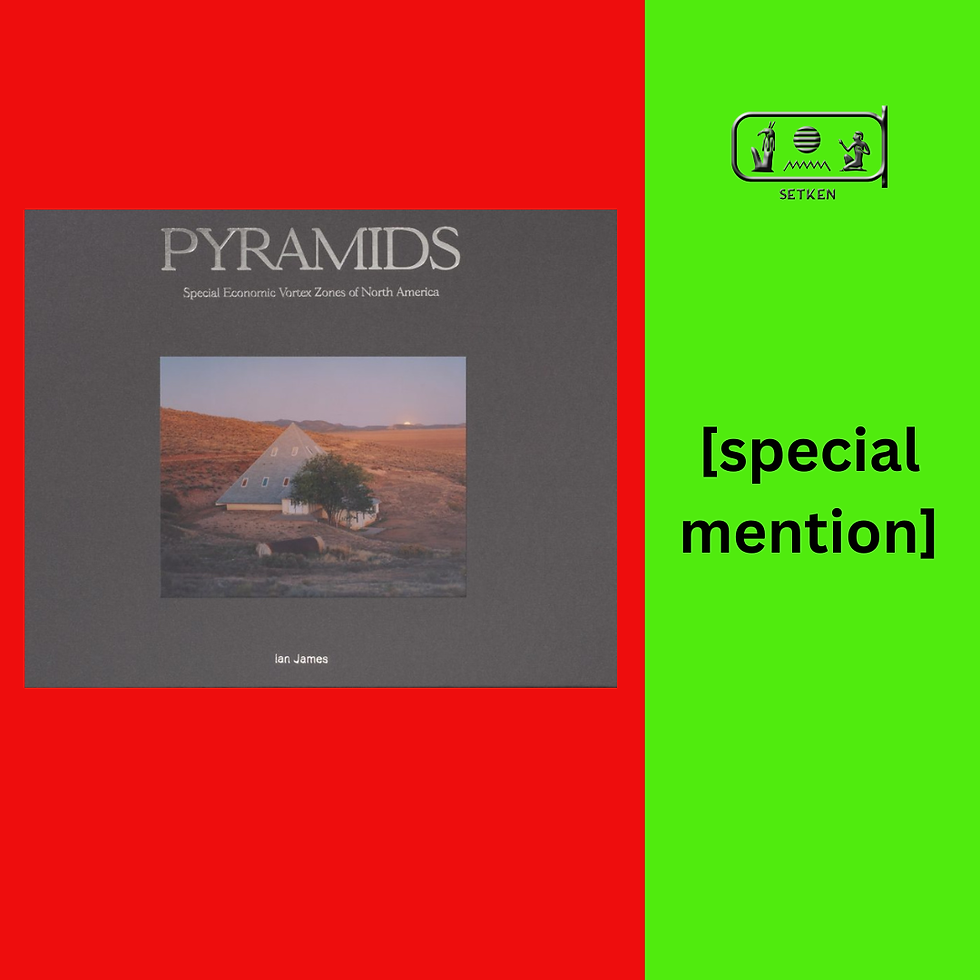
Honourable mention: Ian James’ Pyramid book was also a fave, and I did a separate blog about it here.