
The David Syme Statue


I am a long-time admirer of a statue of David Syme that is situated in the Yarra Ranges[1]. It has always featured at the beginning of my talk A Monumental Egyptian Tomb In Melbourne, and is referenced in the first and last chapters of my forthcoming book about David Syme and his tomb, The King Of Melbourne.
Commissioned by the GPT Shopping Centre Conglomerate for its Chirnside Park complex as a gift for the people of the Yarra Ranges, the sculpture was created by world renowned artists Gillie and Marc. I was recently granted an interview with the couple to feature in the book and this blog.

David Syme was a Scottish immigrant who came to Melbourne in the goldrush of 1852. Abandoning short lived ideas of being a preacher as a young man – his father’s profession – he abandoned the idea as did his two elder brothers George and Ebenezer, who were to join him in Melbourne later.
Before leaving Scotland, he had worked for a short period in a Glaswegian newspaper, something that portended his future as the co-owner of The Age first with Ebenezer, and later as sole proprietor.
It is with the building of this powerful newspaper that David Syme is most prominently linked, but there were many dimensions to the man. He was an author of four books, a pastoralist with many properties at the end of his life (hence the statue in the Yarra Ranges where many of the properties were situated), a freethinker, Protectionist, and Spiritualist.
It is not known how long he remained a Spiritualist, though evidence shows that these ideas stayed with him for the rest of his life. This along with an interest in Ancient Egyptian spirituality found its expression in his remarkable tomb in Boroondara (Kew) Cemetery.

The sculpture is arranged on the bench so that at least one another individual can sit on the bench next to him. David Syme enjoyed riding on trams, preserving his anonymity (photos were not published frequently in newspapers until later in his life) and occasionally partaking in conversations with fellow riders, completely unaware that they were talking to one of the most powerful men in Colonial Melbourne.
The statue is cast in bronze, and its colour was achieved via a carefully applied patina which was chemically bonded to the bronze surface. I am intrigued by the statue for its elegance and charm. A prominent Syme descendant told me that the forehead was absolutely captured in the statue, among other defining qualities.
The commission came about “through discussions with the Chirnside Park Shopping Centre team, who were interested in creating a meaningful and enduring public artwork that connected the site to local history”, said Gillie and Marc.
The artists told me that the project commenced around 2015, following a period of research and consultation with GPT about how best to honour his legacy in a contemporary public space.
“From initial concept and research through to final installation, the sculpture took approximately 12 months to complete”, they said. “The physical making of the sculpture occupied only part of that time, as a significant portion was devoted to historical research, drawing, modelling, refinement, mould-making, casting, and patination”.
I wondered if the statue that we see at Chirnside Park had a prototype, if there was for example any ideas entertained of him standing for example?
Gillie and Marc: “We wanted the sculpture to feel human, approachable, and integrated into daily life. There were early discussions and sketches exploring standing poses, but the seated figure reading a newspaper felt truest to Syme’s identity and legacy. It also allowed the sculpture to function as a public bench, inviting people to sit beside him and, in a sense, join him”.
Given that there are very few photos and portraits of David Syme in the archival record, how were the artists able to come by such a striking representation?
Gillie and Marc: “When likenesses are scarce, understanding the person behind the image becomes essential. Our aim was not only to reproduce features accurately, but to convey a sense of intellect, presence, and quiet authority - qualities that felt intrinsic to David Syme and helped guide every sculptural decision”.
Was there an unveiling ceremony for the statue?
Gillie and Marc: “There was no formal unveiling event in the traditional sense. Instead, the work was quietly placed on site as part of the everyday environment of Chirnside Shopping Centre. In many ways, this felt entirely appropriate. Rather than being experienced in a single moment, the sculpture has been encountered gradually by people passing through, sitting beside it, and discovering it over time. Its reception has been ongoing rather than ceremonial, allowing visitors to form a personal, everyday relationship with David Syme, returning to him again and again as part of their daily routines”.
If you were asked to do a statue of one of Syme’s contemporaries, who would you choose?
Gillie and Marc: “ . . . Figures who shaped Melbourne’s cultural, intellectual, or civic life particularly those whose stories are complex or under-told are always of interest to us. Someone like Alfred Deakin or another key figure from that formative period could offer rich sculptural and narrative possibilities".
Deakin would have been my choice too, and I secretly was hoping they would choose him. Sculpting that mo’ would be a challenge though, I am guessing!
It is not lost on me that Gillie and Marc are artists known for their sculptures of animal headed human bodies, a concept intrinsic to the Netjeru, the gods of the Ancient Egyptian civilisation.
Did they know about David Syme’s interest in Ancient Egyptian spirituality?
Gillie and Marc: “Yes and we found that connection fascinating. While this sculpture is firmly grounded in realism, our broader practice has long explored myth, symbolism, and the spiritual lives of cultures through history. Knowing of Syme’s interest in Ancient Egyptian thought added a quiet layer of resonance for us. Even though it is not overtly referenced, the stillness and timelessness of the seated figure perhaps echo something of that eternal, contemplative quality found in ancient statuary”.
That answer is sublime and given the statue, unsurprising. Given my own interests in the Egyptian gods, I had to slip this question in: if each of you had to choose an Egyptian deity to sculpt a full-size Old Kingdom-style statue of your own, Who would you choose?
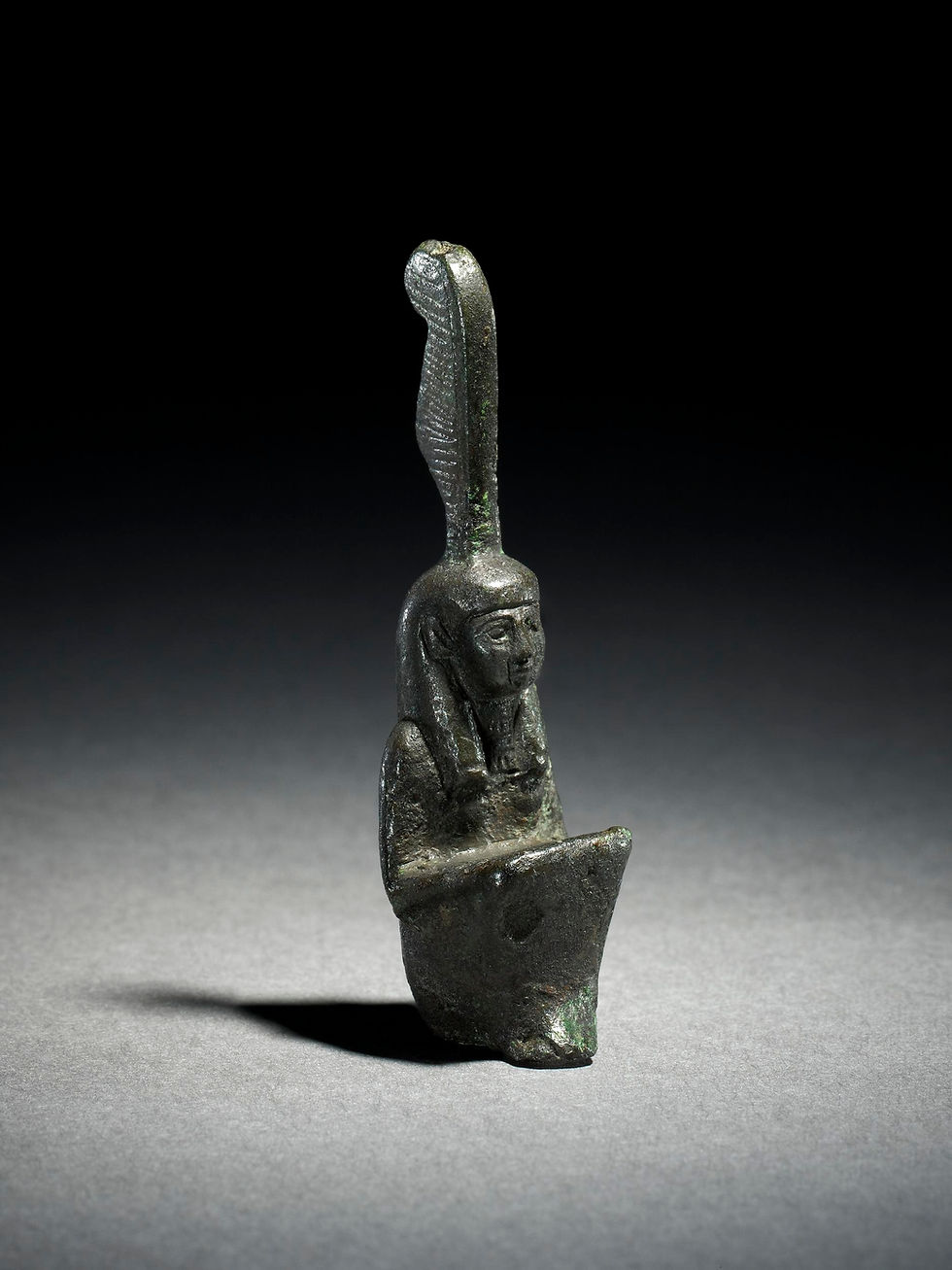
Gillie and Marc: “. . . we would be drawn to Ma’at, the embodiment of balance, truth, order, and harmony. Ma’at represents the delicate equilibrium between humanity, nature, and the cosmos, a principle that feels profoundly relevant both to ancient civilisation and to the world we inhabit today.
What fascinates us about Ma’at is that she is not a goddess of domination or spectacle, but of responsibility. Her presence is quiet yet absolute; a moral architecture rather than a physical one. To sculpt her at full scale would be an exploration of stillness, proportion, and permanence, echoing the timeless restraint of Old Kingdom statuary while allowing space for contemplation rather than awe.
In many ways, Ma’at reflects the values we strive to express in our own work: a belief in coexistence, ethical stewardship, and the enduring power of balance over force”.

The full interview with the artists will be featured in my book. I will discuss this statue – as well as another associated with David Syme, the gigantic statue of Mercury in the Melbourne Museum - at the upcoming Victorian Occult Conference this May 16th at the Ballarat Mechanics Institute. Booking can be made via the link.
Pre-orders for my book can be made here. A big thank you to Gillie and Marc for taking the time to be interviewed.
[1] I painted a render of the statue in two works in 2023 https://www.setken.com/post/13-the-soul-and-david-syme-i and https://www.setken.com/post/14-the-soul-and-david-syme-ii


